Monday, 12 September 2016

Copyright Licensing


Prior to this class the idea of copyrighting only seemed like a distant concept that only really applied to people in the music industry.  But boy, was I wrong.  I have learned, especially now that I am a Teacher Candidate, that we are not necessarily allowed to throw any old video up on the screen to show my students.  It in fact, needs to have this magical thing called "Creative Commons".  Basically this means that the creator has allowed distribution rights for their work.  It is split into six different licenses that dictate exactly what the author gives permission for such as sharing, non-commercial uses, or attribution.  I need to be aware of the distinction as well as help my students practice appropriate internet usage.  Resources such as the wiki page Copyright Friendly or Creative Commons Chaos can help students learn to navigate what is allowed to be shared or not.  Further, it is important to understand "Fair Dealing" as it dictates further what we as teachers are allowed to share with our students as educational resources.  As long as the purpose is for research, private study, criticism, review, news reporting, education, satire, or parody we are allowed to present copyrighted material.  This is very important in order to ensure that our resources for students are legal and usable!  It has definitely helped me think twice about the materials I am sharing!  Just check out these images.  
Slaughter, M. (1983).Children like Kim Hampton; 9; (left); and David Demers; 11; are plugging into computer camps with eletronic speed. Photograph.  Retrieved from http://www.torontopubliclibrary.ca/detail.jsp?Entt=RDMDC-TSPA_0005893F&R=DC-TSPA_0005893F.
Brown, V. (December 28, 2011). Child's Play.  Photograph.  Retrieved from https://www.flickr.com/photos/vintuitive/6585812185/

Monday, 29 August 2016

Back At it Again with the New School Year

Hello loyal followers,

I hope you are ready for another whirlwind blog posting season because we're back bigger and better than ever.  Learning with Miss Lauren 2.0: Teachers College Edition.  Even if this blog doesn't give me a professional edge someday I hope some principals at least find me amusing.  But anyway down to the nitty gritty, I am super excited to be back this year!  Today marks my last first day of school EVER! Until I'm actually teaching and then I have a new first day every year but you get the idea.  I'm pumped to be participating in this tech class because 1. I love technology, and A. I love sharing it with people so finding new ways to get my students involved is awesome!  One of the really cool sites I learned about on my very first day was Answer Garden.  Which is basically a page you can type things you are interested in and see what an entire group writes and how many times each thing was written. FYI Bryan, I was the one who wrote cheese... because c'mon, it's cheese.
As this year progresses I am excited to continue to learn new resources as well as find ways to integrate media that I already love into my teaching practices! 

See you next time my little learners! (which is what I've decided to call you from this point on).


Wednesday, 16 March 2016

Mental Health in the Classroom

Whether we like to admit it or not, mental health has touched our lives.  Either someone we know or ourselves have been affected by mental health illness in one way or another.  And the really sad part is, we don’t like to admit it.  The stigma around mental illness is so strong that people would rather hide and hurt than reach out.  


Before grade 11 the word suicide had very little significance to me.  I knew what it was but I never imagined it could ever directly impact my life.  It was one of those things that you heard about happening in other places but not in your own school, not to people you knew.  Walking out of basketball practice on the night before the first day of the new school year will never leave my memory.  My teammate turned to us as whispered, “Josh committed suicide.”  I looked at the faces of the girls around me, shock and disbelief radiated through us all.  I saw tears hit a few of the girls faces but all I could do was stare.  Walking into school the next morning felt so alien to me.  I was surrounded by crying classmates and teachers attempting to console.  We were immediately called to the gym for an assembly to announce the tragic news, and offer up services that the school would be offering to any students who needed to talk.  

Two weeks later it happened again.  I walked into school to have a friend pull me aside and tell me that my friend, the boy who attended my first birthday party had committed suicide.  The school went into a spiral.  What was just one tragic event had turned into an epidemic.  Over the course of the next two years there would be 6 suicides between my school and neighbouring ones.  Even after watching the turmoil that was happening in the schools, how it tore everyone apart, and listening to the speeches asking people to reach out… no one did.  

Coming from a small town there was not a single person who was unaware of what had happened.  Someone was always connected by a parent, or a sibling, or a friend.  The entire community was is mourning over lives taken too young.  ‘Permanent solutions to end temporary problems’ my mother called them.  Schools were forced to address issues that had never been present before; suicide, depression, and mental health all became a main focus.  Every teacher was on the watch for ‘at-risk’ behaviour, and every student mourned the death of a peer.  From this point onward, our community would never be the same.

But what are we really doing to stop the epidemic? Small steps are being taken, sure, but is it enough?  Even widely popular awareness events such ‘Bell Lets Talk Day’  and ‘To Write Love on Her Arms’ are only once a year.  This is why mental health literacy is such an important concept to include in the classroom.  


Employing mental health literacy in the classroom teaches students how to promote and maintain good mental health as well as how to be there for others.  By teaching mental health literacy we will be able to reduce the stigma that surrounds this topic and show students that this is not something to be ashamed of, there are options and resources available.  Even starting small as teaching students to understand their own identity, recognize the impact of their actions, and learning how to be resilient, as the Ontario Curriculum now includes (2015).  

It is our job as teachers to create an environment which fosters positivity and empathy for others.  Guest lecturer, Dr. Mark Castrodale, discussed how mental health literacy is connected to so many other topics as well such as race, gender, and sexuality (M. Castrodale, Personal Communication, February 3, 2016).  It is also important to discuss mental health literacy in the context of other concepts as well.  We can’t look at someone and say “they committed suicide because they were mental ill” end of story, we need to do a better job understanding the reasons behind their actions.  We need to understand what were the reasons that caused all those young kids in my hometown to take their lives and improve those, not just use a band-aid solution on an underlying wound.  


The reason I chose to make this blog so personal is because I know that these experiences are going to greatly shape my life as a teacher.  As Drake, Reid and Kolohon (2014) note, teachers make meaning of their practice through their own personal experiences and beliefs.  In an effort to become a ‘reflective practitioner’ (Drake, et. al., 2014) I would like to use these stories to grow and guide my teaching practice so that the voices of my students do not go unheard. What my community experienced is not something that I would ever like to repeat and because of it mental health literacy will always be a big part of my classroom.  


Reference


Bell Canada (2014). Bell lets talk: Suffering in silence. https://www.youtube.com/watch?v=tri5ZQaiM7M. (Video).

Drake, S. M., Reid, J. L., & Kolohon, W. (2014). Interweaving curriculum and classroom assessment: Engaging the 21st century learner. Don Mills, ON: Oxford University Press.


Ontario Ministry of Education (2015).  The Ontario curriculum grades 1 to 8: Health and Physical Education.  https://www.edu.gov.on.ca/eng/curriculum/elementary/health.html

Wednesday, 24 February 2016

Critical Literacy

For this blog I wanted to reflect on a concept that we discussed in lecture and that would be critical literacy.  I feel that growing up the term “critical thinker” was something on rubrics that kind of just went over my head.  I did not know what it really encompassed or what actually made me a good critical thinker or not, it was just two words on my report card.  Discussing different literacies has really opened my eyes about how critical literacy is not just one part of a report card, it is actually an entire approach that changes the way both teachers and students look at curriculum, and just all information in general.  

The reason I wanted to discuss this is because I do not want students having the same experience I did and simply look at critical thinking as a box that needed to get checked off rather than actually understanding it’s importance.  Our world is constantly becoming more diverse so being able to understand not only the perspectives and opinions of people around you, but also having the ability to determine fact from fiction in the information that is being presented to us whether it be in textbooks or in the media.  Youths today are exposed to so many sources of information, television, magazines, social media, even Buzzfeed articles that decide they are the expert on telling us “what we really need to know.”  Critical literacy is so important to teach in these times because students need to be able to see the bias in different sources.  They need to understand the motivations authors may have for making certain truth claims instead of blindly soaking it up as fact.  

This educating can start at such a young age so that the time they are starting to grasp larger global concepts they already know how to question what is being presented to them.  The video below from Pear Tree Education Inc. (2013) shows some ways of how critical literacy can be tackled in the classrooms at young ages.  


Some of the methods of critical literacy that really stood out to me from lecture were ‘problem posing,’ ‘juxtaposing,’ and ‘making connections,’ (personal communication, Lane, February 3, 2016).  I was really interested in them because I believe they are practices that can be carried through all of a student’s educative journey, no matter the age, and into the rest of their lives. 

Problem posing is something that can come so natural in conversation so to me it seems like such an interesting tool to use in the classroom.  Playing devil’s advocate can be so fun so using it to encourage students to see both sides of a story, who the information is targeted at, is there other meanings, etc. can really help them build their ability to think critically and even help them become better and simply explaining their thought processes.  

Juxtaposing was a really interesting idea to me because it seems like something that can be built on so much over the years.  Books like “The True Story of the 3 Little Pigs” are fun ways to get students comparing perspectives that can eventually turn into companies news stories or articles on major issues!  Even tasks such as class debates could be effective as students learn about opposing sides and can even learn to argue a topic they might not necessarily side with and gain new knowledge.  

Finally, making connections was in my mind one of the most important strategies in learning critical literacy.  All teachers want their students to fully understand the concepts that are being taught not just have surface learning like memorization.  Having students be able to take the information they are receiving, look at it, and recognize how it can affect their lives or make some connection will really help them internalize the knowledge and hopefully help them become a life long learner.  To me that is the true goal of teaching.  


Making critical literacy practices common in the classroom will help them not only become better learners but better citizens as they will be able to reflect information and understand the perspectives of those around them.  So instead of just seeing a box to check off on the rubric, they see new ways to examine the world.  

Wednesday, 13 January 2016

21st Century Literacies

Blog round 2, here we go!  To kick things off my name is Lauren, my ideal pet would be a lilac coloured cat and I drink more milk than the average human being.  Remember when our introductions weren’t immediately our school year and major? I miss those days, and some day when we’re asking our students to introduce themselves they are going to be a lot more creative than we are in our introductions now, or at least I hope.  Because really, what self-respecting 9 year old is going to stand up and say “Hello, I am in grade 3.” No they’re going to get right down to business and tell you that their favourite dinosaur is a Majungasaurus.  

Ok anyway, back to the task at hand, 21st century literacies.  This is a phrase that I have heard over and over again for the past 4 years but I don’t think I’ve ever sat back and really though about what all this covers.  Mostly, because all of the different literacies were never really discussed as I was growing up.  It seemed to me that literacy meant books or occasionally media literacy.  It is only now that I am slowly becoming more and more familiar with how many different directions literacy could go, and how many I wish I knew more about! For instance financial literacy… because, I mean, taxes? What are those? 

The access we have to different literacy platforms is endless and it is our responsibility as future educators to make sure our students are, you guessed it, LITERATE! This doesn't just mean the can recite the words on a page anymore, it is so much more than that.  Digital literacy, global literacy, environmental literacy, moral literacy, and more!  Our world is not static, so why do people expect education to be as well? The more topics and literacies we are exposed to and teach students about the more they are going to learn and become well-rounded citizens? And isn’t that kind of our goal? To make the next generation even better than the last? 


I am very excited to continue through this course so that I can continue to build on the knowledge of 21st century literacies that I already have, and expand into topics that I haven't even thought of before.  The more we learn, the better teachers we are going to be when it is time to actually get our own classrooms.  We will be more competent and more open to the changing world around us.  And I think its safe to say that none of us want to be that teacher and the front of the class struggling to make a video full screen.  No, we want to be the ones familiar with new technologies and ideas making children excited to learn!  These thoughts are what motivate me in the course to learn more about 21st century literacies and practices and not have students yelling at me “no click the other button Miss Dann!”  

Tuesday, 3 November 2015

Assessment Time!

So many students live in fear of the word ‘assessment’ because we are afraid of performing poorly.  I think for a lot of kids growing up, myself included, your self-worth was reflected in the grade at the top of your test.  That grade was going to influence what my teacher thought of me, my parents thought of me, and what I thought of myself, because more than anything I wanted people to think of me as smart.  Students are so focused on the number, the prize at the end that they are missing out on the actual learning experiences.  I believe this line of thinking kills the love of learning.  

We need to start teaching students that assessments are not something to be afraid of, they are opportunities to shine and show teachers what they have learned.  Drake, Reid, & Kolohan (2014), discuss the benefits of involving students in the assessment process. Effective peer and self-assessment rely on being assessment literate (Drake et al., 2014).  This to me seems like a team effort between both students as well as teachers.  Teachers and students need to work together to make sure not only the content is understood, but what will be expected of them assessment wise as well.  Dr. Eddy White (2009), created a slideshow on what it means to be assessment literate, and notes that above all thing the goal of assessment should be to improve both learning and teaching.  By having students involved more in the building of assessments hopefully it will make students more comfortable and less afraid to fail.  The image on the left was taken from Ed Prep Matters and it outlines how students do want to be involved in assessment building! By doing simple activities such having the class work with the teacher to create a rubric or the guidelines for a project can make everyone aware of what is required of them in order to succeed.  There are plenty of resources available, like education.com for teachers to become assessment literate and how this process can make their students more active learners!

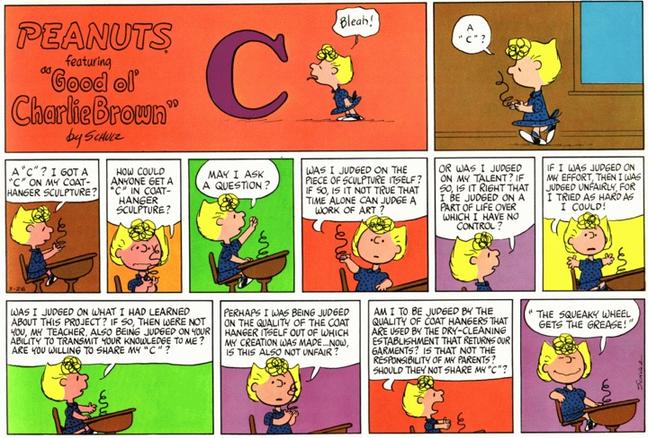
Drake et al., (2014) also discuss peer-assessment as a way of creating assessment literacy.  By teaching students how to give appropriate, articulate feed back, (Drake et al., 2014) students begin to recognize ‘what about this was well done?’ ‘what could be done better?’  which in turn helps them be able to turn around and evaluate their own work in order to improve.  This helps students understand that learning is a process and there are always things that can be improved upon, there is always more we can learn, and more ways we can push ourselves.  It teaches students to become reflective, critical thinkers, connecting their work to their outcome, (Drake et al., 2014).  Although the comic above by Charles M. Schulz is meant to be humorous, it draws attention to the fact that it is important for students to understand where their grades are coming from, especially if we want them to take these experiences and improve on them for the future.  


I’m sure that many students have heard the words “pass your test to the person behind you to mark” but this is not true peer-assessment.  Students are one of the best resources a teacher can use!  Feedback is so valuable in becoming an active learner, so we should teach students to take advantage of it from a young age.  As adults we constantly rely on the input and feedback from our peers in order to present our best work, so why shouldn’t students do so as well.  Unfortunately, likely every student can think of an assessment experience that was less than positive, however by incorporating students into our assessment practices we can help students get to a play where assessment becomes a reflection of growth that they are not afraid of, instead they are eager to demonstrate what they have learned. 

References

Barnes, S. (2014).  Report Shows Need for Better Assessment Literacy.  Ed Prep Matters.  http://edprepmatters.net/2014/05/report-shows-need-for-better-assessment-literacy/

Drake, S. M., Reid, J. L., & Kolohon, W. (2014). Interweaving Curriculum and Classroom Assessment: Engaging the 21st Century Learner. Don Mills, ON: Oxford University Press.

Schultz, C.M., (2015). "C". http://www.peanuts.com/comics/#.VjlcEa6rSt8

White, E. PhD. (2009). Assessment literacy for effective classroom-based assessment.  http://www.slideshare.net/ewhite/assessment-literacy-effective-classroombased-assessment-presentation-907377

Witte, R. H. PhD. (2010).  Assessment Literacy in Today’s Classroom.  Education.com. http://www.education.com/reference/article/assessment-literacy-todays-classroom/

Tuesday, 6 October 2015

Knowing Your Students


Charlotte (2012). http://fabulous5thgradefun.blogspot.ca/2012/08/getting-to-know-your-who.html 


Teachers and students are together on average 5 days a week, 6 hours a day, 10 months of the year so it is pretty easy to get familiar with one another.  What we as teacher need to do is use this familiarity to provide students with the best possible learning opportunities.  Getting to know your students can be vital in order to recognize their strengths and weaknesses, and influence the way you teach them, (Drake, Reid, & Kolohan, 2014).  Although there are some parts of the curriculum that we will be teaching year after year, every student and how they learn will be different.  In order to maintain a growth mindset teachers need to be willing to evolve their techniques rather than just giving lessons or assessments the same way over and over because they ‘worked’ a few times.  

Getting to know students interests and experiences can help us make students more interested in what is being taught, especially if we can take those interests and create a connection to the curriculum.  I think these is sometimes a stigma around teaching in that people think our approach is “we’re just going to give you the information and if you can’t learn it, that’s your fault.”  Getting to know what our students like and dislike, what they are good at, what they need help with, and what teaching methods works best, will show people that our intent is for students to succeed, not to just throw curriculum at them.  

The benefits of actually learning about your students are endless.  We don’t even have to keep the learning restricted to just in the class.  Drake et al., (2014) discuss how learning about students’ home lives, including social, cultural, and socioeconomic backgrounds can help us enhance their experiences in the classroom.  We can find ways to create a classroom environment that adheres to everyone.  For example if we know students come from a lower SES area we can do our best to provide snacks, for students from different cultures we can find ways to include their diversity, and even more we can find ways to make all these unique attributes connect to curriculum to make learning relevant and interesting.  

THIS BLOG by Education World outlines some amazing thought on the value of actually getting to know your students.  The allow us to recognize changes in emotion which can help to see if students are having good or bad days. They let us see them as unique personalities, which can be beneficial in seeing who works well together and defusing problems. Additionally, it tells students that you care about them as people, which can help you gain respect in the classroom.  

There are tons of resources on line as well that can aid teachers to developing positive relationships with their students.  THIS WEBSITE by OLE Community has made a list of creative ways to get to know your students and build a strong environment.  The image on the right is from a website call Teachers Pay Teachers that offers resources.  A sheet as simple as this can help build a bond.  

From a students perspective I know how valuable these bonds can be to build with a teachers.  In high school I had some issues resulting in a suspension, but because I had already developed ties with my teachers they were all really kind and understanding.  No one made me feel like I was a bad kid, just made a bad decision.  One even said that if anyone gave me a hard time to let them know and she would take care of it.  These responses made me feel really respected and made me more determined to do well in class, especially in the ones of the teachers who reached out to me.  I hope that by getting to know my students I will be able to develop these relationships that inspire children to succeed and give them the best possible learning environment.  

References

Charlotte (2012). http://fabulous5thgradefun.blogspot.ca/2012/08/getting-to-know-your-who.html 

Drake, S. M., Reid, J. L., & Kolohon, W. (2014). Interweaving Curriculum and Classroom Assessment: Engaging the 21st Century Learner. Don Mills, ON: Oxford University Press.

Education World (2012).  The secret weapon: Getting to know your students.  The New Teacher Advisor.  http://www.educationworld.com/a_curr/columnists/mcdonald/mcdonald013.shtml

OLE Community (2013).  56 creative ways to get to know your class.  http://olecommunity.com/56-ways-to-get-to-know-your-class/

Teachers Pay Teachers (2012).  "Getting to Know You"- learn about each student in your class.  https://www.teacherspayteachers.com/Product/Getting-to-Know-You-learn-about-each-student-in-your-class-246790